
Taupō District Business Sentiment - September 2026
Summary
The September 2026 Taupō District Business Sentiment Survey shows an improvement in business confidence and trading conditions following the more cautious outlook recorded in April. While some improvement in business sentiment may reflect the approach of the summer season, several indicators are also stronger than September 2025.
Business confidence has strengthened, customer demand is improving and fewer businesses are reporting declining revenue or profitability. Expectations for the next six months have also improved, with almost half of businesses expecting revenue to increase and more than 40% expecting improved profitability.
Growth intentions have also strengthened, with almost 60% of businesses planning to grow over the next six months. Businesses are planning to invest across staff development, technology, recruitment, AI and automation, equipment, and new products or markets.
The improvement is not being felt evenly across the business community. Professional services, retail and parts of the visitor economy are showing some of the clearest signs of stronger demand, while parts of the trades and services sector remain more cautious. Profitability also continues to lag behind revenue performance, suggesting operating costs and tighter margins remain a challenge for some businesses.
Businesses remain more confident about their own prospects than the wider economy. Views of both the New Zealand and Taupō District economies have improved from the weaker outlook recorded in April, particularly looking ahead, although businesses remain cautious about the strength of the wider economic recovery.
Consumer demand and market confidence is now the most commonly identified pressure on individual businesses, replacing fuel and transport costs as the leading concern in April. Cost of living and inflation remains the leading concern for the wider Taupō District economy, alongside housing, workforce availability and tourism demand.
Key Insights
September 2026 results compared with April 2026
66% Confident in their business Up from 56% | 42% Experiencing increasing customer demand Up from 27% | 49% Expect revenue to increase Up from 27% |
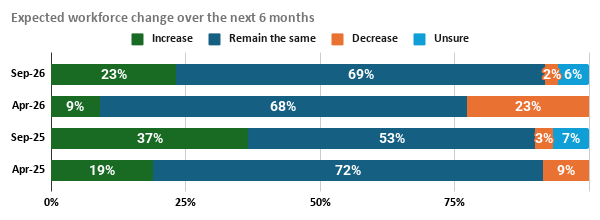
43% Expect profitability to increase Up from 13% | 59% Planning to grow Up from 44% | 23% Expect to increase workforce Up from 9% |
Business Confidence and Demand
Confidence In Own Business
Business confidence strengthened in September, reversing the decline recorded in April. 66% of businesses described themselves as somewhat or very confident, up from 56% in April, while the proportion feeling concerned fell from 29% to 17%. Business confidence is now the highest recorded across the survey series.
Confidence has improved across several parts of the business community. Retail businesses were particularly positive, with more than 80% reporting confidence in their own business. Accommodation and professional services also showed relatively strong confidence, while trades and services businesses were more cautious.
Tourism sentiment is positive but more mixed. Forward bookings, international visitor activity and expectations for the upcoming summer season are supporting confidence, although some businesses continue to report softer domestic spending and uneven visitor activity.
Comments from businesses point to improving sales, forward bookings, repeat customers and a better-than-expected winter for some. Despite the improvement, household spending, operating costs and wider economic uncertainty continue to temper confidence.

Business Demand
Customer demand has improved significantly. 42% of businesses reported increasing demand, up from 27% in April, while declining demand fell from 33% to 18%.
Stronger demand is particularly seen across professional services, retail and parts of the visitor economy. Retail feedback points to improving sales and a better-than-expected winter for some businesses, while professional services also reported stronger demand.
Tourism businesses reporting stronger demand commonly referred to increased forward bookings and international visitors ahead of summer. However, conditions remain mixed, with some businesses continuing to report weaker domestic spending and the need for greater visitor activity.
Trades and services were more likely to report declining demand, with feedback pointing to softer work pipelines and reduced discretionary spending.
Despite the improvement, consumer demand and market confidence remains the most commonly identified pressure on businesses. This suggests businesses are seeing more activity, but remain sensitive to changes in customer confidence and discretionary spending.

Business Performance and Outlook
Revenue and Profitability
Revenue performance continued to improve during the six months to September. 39% of businesses reported increased revenue, while 21% experienced a decrease.
Professional services and retail showed some of the clearest signs of revenue growth. Professional service businesses reported growth through specialist expertise, repeat business and increased activity associated with geothermal growth and investment. Around half of retail businesses also reported increased revenue, with some describing a stronger winter than expected.
Tourism performance was more mixed, with around 40% reporting increased revenue while around one-third experienced a decrease. Trades and services also remained mixed, with revenue growth less clear than across professional services and retail.
Profitability continues to lag behind revenue performance. 24% reported increased profitability and 29% a decrease, down from 39% in April. This gap is particularly seen across retail and tourism, where stronger activity has not translated into the same improvement in margins.
Operating costs, cashflow pressures and cautious consumer spending continue to feature in business feedback, suggesting trading conditions are improving faster than business margins.


Outlook for the Next Six Months
Expectations for the next six months have improved significantly. 49% of businesses expect revenue to increase, up from 27% in April, while 43% expect profitability to improve, up from 13%. Only 8% expect revenue to decline and 10% expect profitability to decrease.
Tourism businesses are particularly positive about the coming six months, with more than 80% expecting revenue growth. Forward bookings and expectations for the summer visitor season are supporting this outlook. Retail, accommodation and food service businesses also show stronger expectations than their recent profitability performance would suggest.
Some improvement from April is expected as businesses move from winter into summer. Revenue expectations are broadly similar to September 2025, suggesting seasonality is likely to be part of the change. However, stronger current demand, improving revenue and increased growth intentions suggest the improvement is not solely seasonal.
Businesses are heading into the next six months with considerably stronger expectations than they held in April, although continued pressure on operating costs means stronger revenue will remain important to improving profitability.


Growth and Investment Intentions
Growth intentions have strengthened considerably, with 59% of businesses planning to grow over the next six months, compared with 44% in April and 38% in September 2025. Only 3% plan to reduce in size, while the proportion unsure about their plans has fallen from 20% to 9%.

Planned Business Investment
Businesses are planning investment across a range of areas. Staff training and development is the most commonly identified at 39%, followed by technology and digital systems, staff recruitment, and AI or automation. Investment in equipment, new products and services, and expansion into new markets also features strongly. Only around 15% reported no significant investment planned. The results show businesses are increasingly looking to build capability, improve productivity and position themselves for growth, rather than simply maintaining current operations.

Workforce and Skills
75% of businesses reported having the workforce they currently need, compared with 80% in April. At the same time, hiring intentions have strengthened, with 23% expecting to increase their workforce over the next six months, up from 9% in April. This indicates businesses are becoming more willing to recruit again, but are taking a measured approach.
The types of roles businesses are finding difficult to fill have also shifted. Professional and specialist roles are now the most commonly identified, followed by trades and technical positions. This differs from April, when seasonal and casual roles were the most commonly identified.
Finding people with the right skills and experience remains a key challenge. Almost half of businesses identified a lack of appropriate skills and experience as a recruitment barrier, followed by attracting talent to the district and work readiness and reliability at 39% each. Wage competition was also a common challenge, identified by 34%. Applicant numbers, housing affordability and immigration issues continue to feature, but were less commonly identified.

New Zealand Economic Outlook
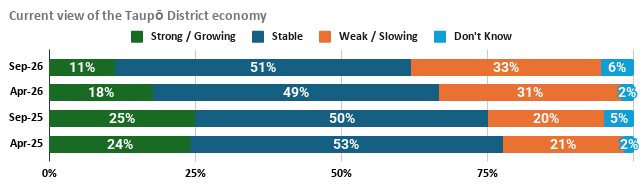
Views of the New Zealand economy have improved since April but remain cautious. 48% of businesses describe current conditions as weak or slowing, down from 62% in April, while 44% consider conditions stable. Only 6% describe the national economy as strong or growing.
Expectations for the next six months have also improved. 19% expect the New Zealand economy to strengthen, compared with 7% in April, while the proportion expecting further weakness has fallen from 66% to 28%.
Despite this improvement, businesses remain less optimistic about the national outlook than they were in September 2025, when 38% expected stronger conditions. Uncertainty is also relatively high, with around 15% unsure about the next six months.
The survey was undertaken in the lead-up to the November General Election, with government policy and political uncertainty appearing in some business feedback. This may also be contributing to uncertainty around the outlook.


Taupō District Economic Outlook
Businesses continue to view the Taupō District economy more positively than the national economy, although their assessment of current local conditions has changed relatively little. 51% describe the district economy as stable, 33% as weak or slowing and 11% as strong or growing.
The outlook has improved more noticeably. 23% expect the district economy to strengthen over the next six months, up from 9% in April, while the proportion expecting weaker conditions has fallen from 42% to 20%.
Expectations remain more cautious than September 2025, when almost half of businesses expected the Taupō economy to strengthen.
One of the more notable findings from the September survey is the difference between how businesses view their own prospects and the wider economy. Business confidence and growth intentions have strengthened considerably, while expectations for the Taupō District and New Zealand economies remain more cautious. Businesses are more positive about their own ability to grow than they are about the wider economic environment.

Business Pressures
Consumer demand and market confidence is now the leading pressure on businesses, identified by 62%. Fuel and transport costs were the leading pressure in April at 65%, but have fallen significantly as a pressure for businesses. Other common pressures include regulatory and compliance requirements, material and product costs, cashflow and working capital, and labour and skills shortages.
The continued focus on consumer demand is notable given the improvement in current demand reported elsewhere in the survey. While more businesses are seeing increased activity, customer confidence and discretionary spending remain key pressures.

For the wider Taupō District economy, cost of living and inflation remains the leading concern, identified by 59% of businesses. Housing affordability and availability follows at 37%, with workforce availability and tourism demand and visitor activity both at 31%.

What Would Make the Biggest Difference to Businesses?
Increased customer demand is the most commonly identified factor that businesses believe would make a positive difference over the next six months, selected by 52%. This is followed by more visitors and tourism activity at 35%, finding new customers or markets at 31%, and lower operating costs at 31%. Businesses also identified greater business connections and collaboration, marketing and promotion, digital technology and AI adoption, and access to skilled workers.
Open-ended feedback also highlighted destination promotion, stronger connections between local businesses, local procurement and attracting new investment. Some businesses called for greater use and promotion of locally owned businesses and suppliers, while others identified opportunities around innovation, technology and diversification.

Priorities for Taupō District Economic Growth
Tourism growth and visitor attraction was the most commonly identified priority for strengthening the Taupō District economy over the next two to three years, selected by 63%. This was followed by supporting existing businesses at 56%, attracting new businesses and investment at 45%, infrastructure investment at 35%, innovation and productivity at 29%, housing availability and affordability at 27%, and workforce development and skills at 20%.
Open-ended feedback also highlighted the importance of retaining more economic value locally, including stronger connections between local businesses and major projects and greater use of local suppliers and professional services.
There is also interest in further economic diversification, with responses referencing innovation, technology, geothermal development, new investment and opportunities for emerging businesses.
Together, the feedback points to a desire to build on the district's existing strengths while creating more opportunities for new industries, investment and local businesses.

AI Adoption Snapshot
The September survey included new questions to understand how Taupō District businesses are currently using artificial intelligence.
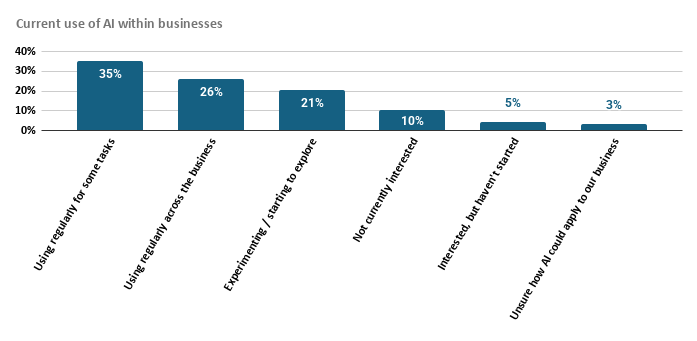
AI adoption is already relatively widespread. 61% of businesses reported using AI regularly, either across their business or for particular tasks and functions. A further 21% are experimenting with or beginning to explore AI.
The most common uses are administration and productivity, marketing and content, and research and analysis. Businesses are also using AI for planning and decision-making, customer communications and aspects of product or service delivery. Around one-third of businesses are planning further investment in AI or automation over the next six months, suggesting use is likely to continue growing.
What the Findings Mean for the Taupō District
The September survey shows improving business conditions, stronger growth intentions and greater willingness to invest. However, profitability continues to lag behind revenue growth, and businesses remain more cautious about the wider economic outlook than their own prospects. The survey responses highlight three areas important to the district's future economic growth.
Supporting business growth and productivity
Almost 60% of businesses are planning to grow, with investment intentions across staff development, technology, recruitment and new products or markets. This creates opportunities to support business growth and productivity, although access to skilled and experienced workers may become a greater challenge as hiring intentions strengthen.
Strengthening local economic opportunities
Businesses continue to prioritise tourism growth, supporting existing businesses and attracting new investment. Feedback also highlights opportunities for stronger connections between local businesses and major projects, greater use of local suppliers and further economic diversification. These connections could help retain more economic value within the district.
Building on improving conditions
Despite stronger confidence and demand, consumer spending, operating costs and profitability remain key challenges. Increasing visitor activity, attracting new customers and growing demand continue to be important priorities for businesses.
The survey responses highlight opportunities to build on improving business confidence while addressing the challenges that could limit future growth. Supporting existing businesses, attracting investment and strengthening local economic opportunities will remain important to the district's long-term growth.
Survey Profile
The September 2026 Taupō District Business Sentiment Survey received 88 responses from businesses across a range of industries and business sizes. Small businesses accounted for the majority of responses, reflecting the wider Taupō District business community, where 85% of businesses employ five people or fewer. Responses were received from across the district, with 80% of respondents based in Taupō and 20% in Tūrangi.
The results provide a snapshot of participating businesses and should not be considered statistically representative of all businesses across the Taupō District.


Comments